
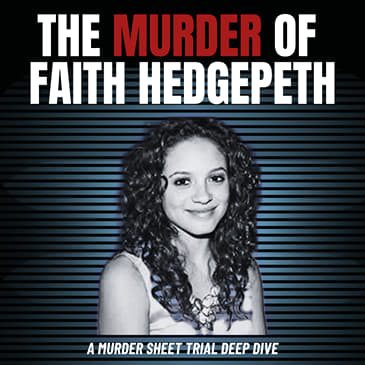
Miguel Enrique Salguero-Olivares is on trial for the 2012 murder of Faith Hedgepeth in North Carolina.
Order our book on Delphi here: https://bookshop.org/p/books/shadow-of-the-bridge-the-delphi-murders-and-the-dark-side-of-the-american-heartland-aine-cain/21866881?ean=9781639369232
Or here: https://www.simonandschuster.com/books/Shadow-of-the-Bridge/Aine-Cain/9781639369232
Or here: https://www.amazon.com/Shadow-Bridge-Murders-American-Heartland/dp/1639369236
Join our Patreon here! https://www.patreon.com/c/murdersheet
Support The Murder Sheet by buying a t-shirt here: https://www.murdersheetshop.com/
Send tips to murdersheet@gmail.com.
The Murder Sheet is a production of Mystery Sheet LLC.
See Privacy Policy at https://art19.com/privacy and California Privacy Notice at https://art19.com/privacy#do-not-sell-my-info.
[00:00:00] [SPEAKER_01] I am in love with Miracle Balm from our new sponsor, Jones Road Beauty. Now, let's be clear, I'm not the biggest makeup wearer in the world. Sometimes I skip wearing makeup because it just doesn't feel good. It's too cakey, it looks bad or off, and sometimes I'm just in way too much of a rush to apply it well. But when I put on my Miracle Balm, it looks natural, fresh, effortless. I put it on and I could head out to dinner with friends or a little date night with Kevin, or we could go to court. I love how lightweight it feels and I love that it gives me a bit of a glow.
[00:00:28] [SPEAKER_01] It's just this kind of clean, natural look that I love. I adore how it enhances my skin instead of just hiding it. Also for me, it's just so convenient. I could put it on really fast. Like one day after we were super busy with the podcast, Kevin and I went out for dinner in a movie, the new MST3K reboot. So even though I didn't have a lot of time, I put it on and loved the way I looked. It took about like five minutes at most. Also, clean beauty is a must for me.
[00:00:51] [SPEAKER_00] This formula is packed with ingredients that love your skin with no phthalates, sulfates or BPA.
[00:00:58] [SPEAKER_01] No clogging, no clumping, just convenient beauty. Miracle Balm requires no brushes. Use it as a highlighter, a bronzer, a blush, lip tint, whatever you want. They'll have you glowing up in 60 seconds. They did for me. Oh, and definitely try their minimalist defining mascara too. The formula leaves your lashes so soft and feathery, no clumps, and it's the most natural looking definition.
[00:01:18] [SPEAKER_01] Modern day makeup that's clean, strategic and multifunctional for effortless routines. For a limited time, our listeners are getting a free full sized mascara on their first purchase when they use code M sheet at checkout. Just head to jonesroadbeauty.com and use code M sheet at checkout. After you purchase, they will ask you where you heard about them. Please support our show and tell them our show sent you.
[00:01:41] [SPEAKER_01] My name is Anya and today we're going to be delving into the fifth day of an ongoing murder trial in North Carolina. Content warning, this episode contains discussion of rape and murder.
[00:01:54] [SPEAKER_01] So, let's talk about why we are all here. We are here because of the murder of 19-year-old Faith Hedgepeth, which occurred September 7, 2012 in Durham County, North Carolina, close to the border with Chapel Hill, where, of course, University of North Carolina, Chapel Hill is located, where Faith was a student. She was a sophomore and she was killed in an apartment she shared with her dear friend, Karina Rosario.
[00:02:23] [SPEAKER_01] And there's just been this kind of lingering mystery in the case for many years because she's found bludgeoned to death. There's a mysterious clue left at the scene in the form of a taunting note. There's male DNA, but they're not connecting it to anyone. And there's just all these moving pieces that no one really knows what to make of. So, this is a case that's haunted the people close to it for many years, I imagine.
[00:02:50] [SPEAKER_01] I imagine it's been awful for Faith's family and loved ones and for the young people who are sort of caught up in this back in 2012. But there was an arrest all the way back in 2021, September 16th. You had nine years and nine days after her death, police arrested and charged Miguel Enrique Salguero Olivares, who was a Durham County resident at the time, and charged him with first-degree murder and then ultimately with some other charges.
[00:03:18] [SPEAKER_01] So, today on the show, we're going to be hearing from the latest slew of witnesses that the state called. We're still on the prosecution's case in chief. Today, we're going to be hearing from a number of folks affiliated with law enforcement and law enforcement officials and former law enforcement who worked on the case in some capacity. We're going to be seeing some highly interesting body camera footage from when police first made contact with the defendant.
[00:03:47] [SPEAKER_01] And we're going to be hearing some interesting things. And if you hear banging in the background, don't worry about it. Our dog's new hobby, this is Nora, our dog, is to carry around bones and then almost to show them off, she kind of just drops them randomly. So, no one's trying to, like, break into our house. It's just a very silly dog. So, that's a note. So, let's get into it.
[00:04:16] [SPEAKER_01] My name is Anya Kane. I'm a journalist.
[00:04:19] [SPEAKER_00] And I'm Kevin Greenlee. I'm an attorney. And this is The Murder Sheet. We're a true crime podcast focused on original reporting, interviews, and deep dives into murder cases. We're The Murder Sheet.
[00:04:31] [SPEAKER_01] And this is The Murder of Faith Hedgepeth, the trial of Miguel Enrique Salguero Olivares. Day 5. One Hundred Percent.
[00:04:40] [SPEAKER_01] So, I think it is important to note here that we are going to be recording this.
[00:05:33] [SPEAKER_01] We're probably going to miss some things towards the end of the day's testimony. So, anything we missed toward the end of today, we'll just include in our coverage tomorrow. So, we actually leave, we actually start where we left off yesterday's episode. Captain Johnny Britt. She is a 23-year veteran of the Chapel Hill Police Department. She was an original investigator working on Faith Hedgepeth's case, was at the scene and everything back in 2012.
[00:06:02] [SPEAKER_01] But, as it happens, she ultimately was sort of promoted out of this investigation. So, you see that with older cases where, you know, the same group that was working on it changes over time. And in this case, it was nothing nefarious. Simply, Captain Britt was promoted, ended up getting a new job. She wasn't an investigator anymore. She was going to be moving up within the department. So, it felt to others.
[00:06:31] [SPEAKER_00] That's the sort of thing you see in any workplace.
[00:06:34] [SPEAKER_01] Yeah. It kind of, it's interesting. I mean, everything for me goes back to the Delphi case that we covered. But that one, it felt very old at the time because it happened in 2017 and then things started rolling in 2022. But, ultimately, at the 2024 trial, you still saw a lot of the same people who were first on it participating. Even if they had been promoted, they were still on that kind of almost task force that focused on it.
[00:07:03] [SPEAKER_01] But that's just not going to be possible or the best thing to do for every case. So, in this case, she was promoted out. But she still has valuable testimony, I think, to hear from someone who was there from the beginning. We started off yesterday with her with, of course, the direct examination from the prosecution. But that concluded and we begin today with cross-examination from the defense.
[00:07:28] [SPEAKER_01] This is the defense's chance to say, okay, let's ask you some tough questions that perhaps doesn't make this investigation look so good. And James Rainsford was doing that. We've been hearing a lot from James Rainsford on the defense team. Although, today, we will get to hear from a second defense attorney, which is good. And with Rainsford, one thing he really wanted to focus on was the timeline as she laid out in one of her reports on the crime.
[00:07:55] [SPEAKER_01] And specifically, he wants to know about the downstairs neighbor of Karina Rosario and Faith Hedgepeth, who came forward to police without really knowing what had happened and said sometime between 3 a.m. and 4 a.m., maybe closer to 3 a.m. based on the testimony, on the morning of September 7, 2012, she heard three to four distinct thumps.
[00:08:24] [SPEAKER_01] Yes. So why would the defense perhaps want to keep bringing that up? Because they certainly brought it up before.
[00:08:34] [SPEAKER_00] Obviously, I think they just think that it's in their interest and it helps them with their goal of trying to raise doubt and raise questions.
[00:08:42] [SPEAKER_01] Especially since Karina Rosario would have left after 3 a.m. Exactly. So someone else would have been in the apartment. So it throws the state's timeline because Karina Rosario, while testifying that she was extremely drunk, never testifies that she saw anyone else in their apartment. You know, that seems like something that would come up if she saw that, despite the level of intoxication. But, you know, I think it's interesting.
[00:09:12] [SPEAKER_01] I think it's fair play to the defense. I don't know if it matters because it's relying on a lot of this person's perception. And there's no screaming or crying or anything really else associated with it. You know, could that have been someone pacing around? I don't know. It's like, to me, it's, I believe the witness and I believe the witness, you know, is being helpful and coming forward with what they know.
[00:09:42] [SPEAKER_01] It's just, to me, it's interesting. It's not the end all be all, I guess, for me. But it's interesting. And, you know, if they can get enough of those pieces, they might get to raise some a little doubt. Because it might be like, well, maybe something else was happening. So, they also cross Captain Britt about an interview she did with Marisol sort of shortly after the murder.
[00:10:07] [SPEAKER_01] They talked about Eric Takoy Jones, who was Karina Rosario's ex-boyfriend, who she accused of abuse. And how possessive he was. The defense is going to want, I'm sure, a lot about him. Because if you have someone who's accused of violence and he's familiar with this location, he used to live there. It was testified to that he kicked down the bathroom door. That's why there was no bathroom door.
[00:10:32] [SPEAKER_01] You know, like, the defense, from their perspective, like, is it out of the realm of possibility that this guy who's angry at Karina shows up? Karina's not there, but Faith is, and he takes it out on her? Perhaps. Perhaps. Problem with that is his DNA is not inside of Faith. We know that this was a rape murder, or at the very least, that she had sexual contact before her murder in such a way that makes me think she was raped.
[00:11:03] [SPEAKER_01] And that's not his DNA. So, a lot of these things are, like, very good moves by the defense, fair play to the defense. But also, like, are they going to stack up against DNA? And the answer, I think, is no at this point. But it's not a static situation, and we're only hearing the state's case at this point. So, let's keep an open mind.
[00:11:26] [SPEAKER_01] You had discussion of different things, like, oh, there was a gas receipt that Faith had gotten gas on September 6th. Criticisms of the handling of the investigation and the crime scene. Why didn't you guys take this towel? Why didn't you take this trash can from the bathroom to test that? And who was responsible for that? So, there was an interesting point where the defense sort of pointed out, like, okay, you're saying that the crime scene investigators were supposed to figure out what to take.
[00:11:56] [SPEAKER_01] But they're saying in their testimony that that was going to be you telling them what to take. You know, kind of, like, implying it wasn't a very good investigation. What do you think about that?
[00:12:10] [SPEAKER_00] Again, that's the sort of thing you expect defense to do. They want to throw doubt on everything. They want to make a juror think, oh, this wasn't a perfect investigation. They made mistakes. And if they made mistakes during the process of their investigation, how much confidence can we have in the conclusions of that investigation? That's their goal.
[00:12:34] [SPEAKER_01] And in my mind, when I'm watching a trial, what I think is helpful, because sometimes I feel like the media especially kind of incredulously reports the defense side because it's more dramatic. Like, crime scene botched, you know, like that sort of thing. And I just think of that, you know, the dude, well, that's your opinion, man. You know, I think it really comes down to the specific set of circumstances.
[00:12:58] [SPEAKER_01] And if you want to think about it in what I think is a helpful way, maybe a picture of several buckets. Maybe bucket number one is the defense is claiming it was a mistake. But is it really a mistake or is it an understandable reality of something that happened? Maybe two is a mistake, but it's not really having any bearing on the outcome of the case. So a minor mistake. And then three is a major mistake.
[00:13:28] [SPEAKER_01] This is something that has corrupted evidence, key evidence. This is something that has really hampered our ability to know the truth on this case. And and or has violated the defendant's rights in such a way that it really deserves to be in its own category.
[00:13:46] [SPEAKER_01] And to me, that's what tends to make me start thinking, OK, where that seems like reasonable doubt right there, because this we can't even trust the integrity of this investigation. That to me, that's the big deal, I guess, in category two, maybe if enough of that stacks up, it can kind of like lead to number three.
[00:14:10] [SPEAKER_01] But that's those are the sort of sins of an investigation as far as the defense characterized it, because certain things are just not even really a mistake. Like they they were kind of grilling her over. Well, the body was moved and she pointed out, OK, so in order to preserve evidence on her hands and feet, your hands in particular might be a good source of DNA if there's any defensive wounds or whatever. Those need to be bagged.
[00:14:39] [SPEAKER_01] We have to move the body in order to bag them. And in my mind, when you say when the defense says the body was moved, I'm like, oh, that's not good. But then when they're like, yeah, because we need to preserve DNA evidence, I'm like, oh, OK, yeah, actually, that makes sense. So I think just you hear out both sides. That's not really a mistake in my mind. But other things they mentioned were a mistake. Like we talked yesterday about how, OK, they lost a swab. That's a mistake. That's it. I mean, yeah, that's a problem.
[00:15:08] [SPEAKER_00] That's a problem.
[00:15:09] [SPEAKER_01] We learned today that the investigators didn't really test the gas cap of Faith's car, which had been left open. And Captain Britt acknowledged, yeah, that was a mistake. You know, that could have been tested. She actually at one point acknowledged that it is important for police to Monday morning quarterback themselves.
[00:15:32] [SPEAKER_01] And to constantly think about what did I not do or what did I do that was wrong that I can learn from at the next scene? Because that is how individuals improve. That is how departments improve. That's how best practices are adopted and implemented. And, you know, that's I thought that was a good answer because it we can't expect perfection from police, but we should expect.
[00:16:00] [SPEAKER_01] Consistent attempts to improve processes and procedures, I think. Especially around important murder cases. I mean, every murder case is important, I would argue. But murder cases in general or serious crimes like rape, kidnapping, things like that. They talk about leads and how they followed up on every single lead they got. We love looking good and saving money. So we love our wonderful sponsor, Quince. The clothes they make are comfortable, affordable, and they don't go out of style.
[00:16:30] [SPEAKER_01] They're those wardrobe staples you'll reach for again and again. We certainly do.
[00:16:34] [SPEAKER_00] I recently got a pearl snap denim western shirt and denim blue that I wear all the time now. For every day and for fancier events and get togethers, it's breathable and comfortable, which is a huge deal for me. And I know as the weather cools, I'll be returning to my Quince sweaters. Namely, my Australian merino wool cable crewneck sweater and my Mongolian cashmere crewneck sweater. Those are so soft and so perfect for the fall. Their Mongolian cashmere sweaters start at just $60. Check them out.
[00:17:04] [SPEAKER_01] Seriously, get them and we can all match. I love my 100% European linen fit and flare midi dress in chili red and navy blue. I got two of them because I love them so much. The fit is so good. I think they're so cute and I've gotten a lot of compliments wearing them. So love that. And as Kevin said, I can't wait until it's a bit colder out so I can break out my Mongolian cashmere sweaters. That's the great thing about Quince though. You want to wear these pieces again and again.
[00:17:28] [SPEAKER_01] These are classic pieces and you're going to want to get even more because these are 50 to 80% less than similar brands because they cut out the middlemen. Refresh your wardrobe without breaking the budget.
[00:17:38] [SPEAKER_00] Find your next fall favorites at Quince. Download the Quince app for app exclusive offers or go to Quince.com. Get free shipping on your order and 365 day returns. Now available in Canada and the UK too. And when Quince asks where you heard about them, let them know it was the murder sheet. It is the best way to support the show. We'd like to give a big thank you to Vented, the sponsor of this episode.
[00:18:02] [SPEAKER_01] For those of you who haven't seen backgrounds of our lives, the clutter has gotten out of hand at our house. So I've decided to make an effort to do some serious cleaning. One of the places I'm starting is in our bedroom closet. I can't believe all the clothes I had in there that I'd probably frankly never wear again. They were taking up a lot of space. But I didn't want to just be wasteful and throw them away. That didn't seem right and they have a lot of life in them.
[00:18:25] [SPEAKER_00] That's when we found out about Vented, a great way to turn the clothes in our closet into money.
[00:18:31] [SPEAKER_01] And also clear up closet space for new clothes.
[00:18:34] [SPEAKER_00] Vented is a secondhand market app that makes it easy for everyday sellers like us to sell our pre-loved fashion items. I love that this app is free to download and there are no seller fees. That means we get to keep everything we earn.
[00:18:51] [SPEAKER_01] Vented makes it so easy to list items. They even help you after an item sells by creating prepaid shipping labels. It couldn't be simpler. And that just makes me want to list more and more items. It makes me feel so much better to have a less cluttered closet.
[00:19:06] [SPEAKER_00] And these days it also helps to be able to earn some extra money. Especially when Vented makes it so easy. That's Vented. V-I-N-T-E-D. See what's hiding in your closet. You might be surprised how much you can earn with Vented. Download the Vented app for free to start listing with no seller fees.
[00:19:27] [SPEAKER_01] Fall means darker days and chilly air. But if you or your partner sleep hot, it can be tricky to get your bedding set up just right. And we all know that health and wellness starts with good sleep. For Kevin and I, that means it starts with amazing, comfortable bedding from our sponsor, Bull & Branch.
[00:19:41] [SPEAKER_00] Stay cozy as the temperatures drop with Bull & Branch. You're never sleep hot again. These sheets are going to help you make your bed feel like the coziest, most relaxing place in the world. Somewhere to snuggle up as the winds blow. Their signature sheets are the key ingredient. But they also provide temperature-regulating comforters. Cozy and breathable blankets. You are going to want to upgrade your entire bed.
[00:20:04] [SPEAKER_01] We certainly did. Our first foray into Bull & Branch was their signature hemmed sheet set in Dusty Rose. Love the color. Love the matching waffle bed blanket. We actually ran out and bought a second set. These ones are sand-colored. That way, we will never have to go back to regular bedding.
[00:20:20] [SPEAKER_00] Once you try Bull & Branch, you will understand. It's like bedding from a really nice hotel. Woven specifically for airflow, not just softness. So you will feel cozy, not hot. We have been getting amazing sleep on these.
[00:20:33] [SPEAKER_01] Plus, I don't know what magic or sorcery they're doing for this, but the more we wash them, the softer they get. I've never had that before. Seriously. Check them out. You're going to melt away. You're going to take your bedtime routine to the max. Bull & Branch sheets are the official pick of the murder sheets from here on out.
[00:20:50] [SPEAKER_00] Upgrade your sleep with Bull & Branch. Get 15% off your first order plus free shipping at bullandbranch.com slash msheet with code msheet. That's bullandbranch, B-O-L-L-A-N-D, branch.com slash msheet. Code msheet to unlock 15% off. Exclusions apply.
[00:21:07] [SPEAKER_01] They also, at one point, the state got to redirect the witness and asked about, you know, what would you do differently? That was sort of her setting her up for that Monday morning quarterback comment. And there was a recross and they were sort of, again, saying, well, wouldn't you want to know if there was DNA on this or that? And, you know, she was able to be like, yeah, we would. But, you know, I thought she was a good witness. She was very calm and professional on the stand.
[00:21:37] [SPEAKER_01] Sort of what you would expect from a longtime law enforcement official. And I think that, for me, she sort of represents this figure, as with the crime scene investigators of the 2012 era of this investigation. And I'm coming away, and I'm open to disagreements or if anyone kind of thinks differently. I'm coming away feeling like this was certainly an imperfect investigation and that there are things that they did not do perfectly.
[00:22:05] [SPEAKER_01] But I'm really failing to see how any of that at all weighs against the DNA evidence found in Faith's body and at the scene.
[00:22:19] [SPEAKER_00] And, yeah, I'd just like to make a point I feel I've made often on the show, and I apologize if I'm repeating myself too much. But anything human beings do is, by necessity, imperfect because we are imperfect creatures. You can point to anything and say, oh, they should have done this, or maybe they didn't do this in strictly the correct way.
[00:22:43] [SPEAKER_00] But the question is, were the imperfections enough to taint the results of the investigation? And in this case, at least at this point, I have not seen anything that would make me think that we should doubt the conclusions of this investigation.
[00:23:01] [SPEAKER_01] Yeah, well said. Better said than I did. Turn around and look at your weird dog. He's looking out the window. What is he expecting?
[00:23:25] [SPEAKER_01] I, do we, Kevin, open the window a little bit for him to look at. We're gonna, he, that, that dog goes on five walks a day. So, I mean, we're gonna take him out after this. Don't think that we're like keeping him cooped up in here while we podcast all day. That's, that, that's not, that's not what's happening. So, anyways.
[00:23:48] So, anyways.
[00:23:48] [SPEAKER_01] Yeah, I think you put it really well. And, you know, I, I'm, I'm still a little bit confused about why it took so long because they had the DNA. I'm not really getting a lot of clarity on that. I may have unrealistic expectations about how fast some of that happens.
[00:24:08] [SPEAKER_01] I also am acknowledging that it's, there's been a lot of discussion like certain groups, ethnic groups, racial groups are poorly represented within the DNA databases. I think they say, like, Caucasians are pretty well represented, but some other groups may not be so well represented. So, perhaps this, this, this man, this defendant is Hispanic. Perhaps that's an issue. I don't know. I'm speculating here.
[00:24:38] [SPEAKER_01] But I am curious about why it did take so long. But that doesn't mean, I think sometimes people feel like a bad outcome or a less than optimal outcome definitely means someone is to blame. And sometimes I think you do get a tough case. A stranger homicide is a tough case because there's no obvious connection to the victim. And a lot of what police do is work backwards from the victim.
[00:25:01] [SPEAKER_01] And if it's just some random guy breaks into your apartment, rapes and kills you, there's not necessarily a nexus there. Except for the DNA, of course. But, yeah. So, that was Captain Britt. The next individual called to the stand was Cesar Gutierrez. And this is another law enforcement official. He is, was, was former special agent with the North Carolina State Bureau of Investigation.
[00:25:30] [SPEAKER_01] In the United States, it seems like some, some of, some of the states have bureaus of investigation of their own. And others, like where we live, have state police. So, I think, you know, state, within state police, you have people who work the road, road troopers who are, and people focused on that. And then you have people focused on the investigative side, which are like big crimes coming in to assist local law enforcement or dealing with certain cases that they have jurisdiction over.
[00:26:00] [SPEAKER_01] And with North Carolina, it seems like these NCSBI folks are kind of dealing with that. And Mr. Gutierrez was in the job in 2021. He was still working there. I guess he no longer does. And one skill he had specifically was he could speak Spanish. He was a native Spanish speaker. He grew up in Chile. He was born there.
[00:26:29] [SPEAKER_01] And he was, he moved to the United States with his family when he was 11. So, he speaks Spanish fluently and often would assist with witnesses or individuals who are native Spanish speakers to just kind of better deal with that. Because a lot of things can be lost in translation.
[00:26:46] [SPEAKER_01] So, September 16th, 2021, he has an interaction with this defendant because he actually goes with Detective Rodney Matthews to this apartment complex where Salguero Olivares is living with his mother in an apartment at the time and confronts him. They basically go to him and start asking him a bunch of questions. They show body camera footage of this and I'll play some of that in a moment.
[00:27:16] [SPEAKER_01] But one thing I found interesting was, you know, it's body camera footage from Detective Matthews. You can see his beard and also like he's holding a phone. You could see face picture on it. And they're showing Salguero Olivares her picture and asking her, him, did you know this girl? Do you remember her? And, you know, this would have been in 2012. Do you remember? And then they're showing him like pictures of Karina Rosario. Do you know her? Why?
[00:27:46] [SPEAKER_01] Why is that a smart technique from police investigators? Like, or what are they? Because once I saw they were doing that, I was like, oh, OK, I know what they're doing. You know. They know at this point that his DNA is inside of Faith Hedgepeth's body. Why ask him? Why not just come into it and say, we have your DNA. We know you had sexual contact with her shortly before her death. Why is it better to say, do you know her? Do you remember her?
[00:28:14] [SPEAKER_00] It is generally better not to lay all your cards on the table immediately. You want to give them a chance to tell a story before you give them all of the evidence you have. Because if you give them all the evidence you have, they will try to construct a story that is in their interest that accounts for that evidence. If you don't give them the evidence, they don't know what you have.
[00:28:42] [SPEAKER_00] They're more likely to either tell you the truth and tell you a story that vindicates them or just say, oh, no, I didn't know her at all. And then you say, well, you're lying because look at what I have.
[00:28:53] [SPEAKER_01] It really undermines the person with the jury. And it also tells the investigator they're lying. They're willing to lie. If someone comes to you and says, do you know this girl? And they unprompted say, oh, yes, we were friends. Here, I'll show you our texts. I was very upset when she got murdered. And that all checks out. Well, that's some credibility. It doesn't mean the person's innocent or guilty. But when you start lying like this, it's consciousness of guilt, too.
[00:29:22] [SPEAKER_00] Yes.
[00:29:23] [SPEAKER_01] And this is what I was talking about earlier in our discussions of the case. Like I was looking for, is there some kind of innocuous connection between Salguero Olivares and Faith that could have led to a consensual sexual encounter? But he is just denying even knowing her all throughout this video. No, no, no, no. He seems irritated. He seems highly defensive. He's got his arms crossed. I don't really care about body language.
[00:29:53] [SPEAKER_01] If two police officers intercepted me outside of our house and started asking me if I was involved in a really serious crime, I would probably be defensive, too. And I wasn't. I swear. So, like, I don't necessarily look, but I'm just reporting what I'm seeing. So, what Mr. Gutierrez testified to was he felt that the defendant was very evasive.
[00:30:22] [SPEAKER_01] And he said something that honestly reminded me of a John Mulaney bit. You know, John Mulaney talking about SVU talks about how two homicide detectives will come interview someone and they'll be too busy, like, unstacking crates from, like, a truck. They said basically that's what he was doing. He was more concerned. He's told we're homicide investigators and we want to talk to you about a murdered woman.
[00:30:45] [SPEAKER_01] And he's much more concerned about his job as a painter than anything else in this conversation. So, obviously, work is important to a lot of people. But I think a lot of people would also stand up and take notice if it's like, hi, we'd like to talk to you about a murder. So, evasive. He seemed off to this investigator, at least.
[00:31:10] [SPEAKER_01] You see him in sort of paint-spattered blue polo and khakis, potentially like a work uniform. You see Gutierrez standing there, dark coat, gold tie tucked in, navy pants. And you don't really see Detective Matthews because it's his body camera. But, yeah, he seems very uninterested and engaging, very defensive. Now, interestingly, Mr. Gutierrez was there to provide language support.
[00:31:39] [SPEAKER_01] But, ultimately, most of the conversation did take place in English. The other thing I'll say is that people are going to get mad at me about this. But, like, certainly it's a bad idea to talk to police investigators if they think you did something. Like, you probably want to lawyer up at that point.
[00:32:01] [SPEAKER_01] But, at the same time, like, truly, if you didn't do anything and there's, like, there – it's, like, more of, like, they're casting wide net in the early days. Like, in my experience, in many of these investigations that are larger, the investigators want to find who did it. But, like, if, like, you give your DNA and you didn't have anything to do with this and there's no evidence connecting with you, they're going to, like – like, you're going to move on, potentially, you know.
[00:32:27] [SPEAKER_01] And most people in those circumstances, if they know, like, there's no way this is getting back to me and I never had sexual contact with this person, I never was even in the room. They're, like, eager to be, like, okay, sure, exclude me because then they're just done. And having someone be kind of, like, reacting with, like, such kind of quiet hostility to, like, I don't know anything, get away from me. It's interesting.
[00:32:56] [SPEAKER_01] It's, you know, it's notable, I think. So, let's play what I felt was perhaps the most dramatic moment in this entire exchange between this defendant and – now, I've run this through some software to clean up the audio, so it's going to sound a little bit different. But all I care about at this point is that it is audible. We talked about mistakes being made by people who are humans.
[00:33:23] [SPEAKER_01] I'm sure you will find many of those within this podcast itself. So, that's case in point. If, you know – and certainly I wouldn't want anyone expecting perfection out of us at this point. So, I don't think it's fair to expect it out of police officers. But expecting competence and professionalism and not violating people's rights, I think we can – we all should expect that. We should have high standards, not impossible ones. So, let's check out this portion of the body cam footage. And the speaker here is going to be largely Detective Matthews.
[00:33:53] [SPEAKER_00] What would you say, Miguel, if I told you that I know that you killed this girl? And that I know that you were there? So, what if I told you that I know that 100%?
[00:34:16] [SPEAKER_01] Dang. That's pretty – that's pretty direct and –
[00:34:21] [SPEAKER_00] That is very, very direct. And I can't imagine what he must have been thinking when he heard the police ask him that question.
[00:34:29] [SPEAKER_01] Yeah. You can – he almost seems like rooted to the spot at this point. Like, he almost wants to leave, it feels like, but maybe he feels like – I mean, at the same time, you might want to know what they know as much as possible. And he's defensive. He's shaking his head no. This is – much of the video, you can't even see his head or face, but in this, you can. And, yeah. They play about 10 minutes of a 90-minute piece of footage.
[00:34:57] [SPEAKER_01] They, like, are continuously asking him about faith and whatnot and, did you know her? And he's just, oh, what do I have to do with her? I don't – I don't know her. I had nothing to do with this. And, you know, just very not cooperative. At one point, his mother comes out and she's talking. And, yeah. But, yeah, at this point, at this point, they kind of are saying, like, we know it's you.
[00:35:27] [SPEAKER_01] They're not saying why yet, but, I mean, they try to kind of provoke him. He – yeah. So, Mr. Gutierrez also talks a little bit about some of the challenges in translating between Spanish and English and how the languages are constructed differently. So, there can just be, you know, some of that kind of talks about the process. And across examination, the defense actually wanted to play their own portion of the video.
[00:35:55] [SPEAKER_01] And it shows earlier, kind of in the lead-up to what the prosecution showed. And they were trying to back it up. And at that point, they kind of give the jury a bit of a break. They get them out of there. But you're seeing the parking lot. You're seeing, you know, they kind of have to approach him and sort of get him to talk to them. And I think the defense's points with a lot of this cross-examination was, like,
[00:36:23] [SPEAKER_01] it's not unusual to be, like, evasive or weird when some random police show up and you don't know why and you want to go to work because people are relying on you and you've got to pick people up and pick paint up. And, like, I saw what they were going for. A lot of this is about evidence for me. Like, I think that's what it all comes down to.
[00:36:48] [SPEAKER_01] And because I've said, hey, you know, if Karina Rosario comes across badly to some people in the 911 call or in various aspects of this, you know, she was a drunk college girl who was going through a really hard time post-abortion, feeling abandoned by men and really wanting male validation and was kind of being a mess. And, you know, given her age, I don't think that's that unusual.
[00:37:16] [SPEAKER_01] And, you know, in a different set of circumstances, you could see this guy being kind of defensive and hunched over and cross-armed and being like, what the heck is this? And they could be totally innocent. They could just be like, I have no idea. Like, I'm shocked. The difference between those two individuals that kind of colors my viewpoint is ultimately the evidence.
[00:37:38] [SPEAKER_01] And the fact that this man was a stranger to faith by all accounts and his DNA somehow ended up in her vagina and her rectum. That doesn't add up.
[00:37:51] [SPEAKER_00] It simply does not add up. It's very difficult to sit here and try to find an explanation for that that is consistent with him not being guilty of this crime.
[00:38:03] [SPEAKER_01] If he'd been just seen on security camera outside and that was the extent of this, then I think we could view this as, you know, well, maybe he could be innocent. And if Karina turned out to have a shirt spattered with face blood that was hidden away but then discovered later, then we could say her behavior might look different. But to me, it's less about behavior and jumping to conclusions about behaviors and more of examining behavior in the context of the evidence.
[00:38:32] [SPEAKER_01] Because what I would expect from someone acting in good faith in his position would be, oh, yes, I do remember her. We went on some dates and, you know, maybe after some coaxing, revealing, okay, and we also had sexual contact. Like, not just, I don't know her. I don't know what I have to do with this. Like, yeah, that doesn't fly when the DNA says what it says. You're lying. Even if you're innocent, you're lying because you had sex with her. If it wasn't a rape, it was some kind of sexual contact.
[00:39:02] [SPEAKER_01] So what gives? Why would an innocent person lie in that scenario? Okay, because they don't want to get in trouble. Yeah, but at this point we're having to, like, really stretch. The defense also wanted to point out, like, he only was told the year 2012, the general proximity. So, like, maybe, like, I think the implication was, like, maybe he forgot. And he told his mother he didn't do this at the prompting of the detectives. And, you know, all that.
[00:39:32] [SPEAKER_01] So there was, you know, there was the back and forth. And that was sort of where Mr. Gutierrez came in. There were two very quick witnesses. One was North Carolina State Bureau of Investigation Assistant Special Agent in Charge, Candace Lanham. And this was done by Brooks Stone, to be clear.
[00:39:57] [SPEAKER_01] The assistant district attorney in Durham County, Lisa Coltrane, the special state prosecutor, did the Mr. Gutierrez direct. And Mr. Stone had her on. This was quick. There was only a very brief cross-examination even. But basically what she did was collect DNA swabs. And from Salguero Olivares. So in September of 2021, she swabbed him.
[00:40:26] [SPEAKER_01] Buckle swabs are sort of the standard when you are dealing with somebody and trying to compare the DNA. So they're non-invasive and they just kind of circle the inside of your cheeks a bit to kind of get some cell material. And then they can compare that DNA with the DNA found at the crime scene. She also talked about getting major case impressions. So those are fingerprints that go past the tip of the finger. So she's the one dealing with that.
[00:40:53] [SPEAKER_01] And everything she was collecting was sent to Chapel Hill Police Department. And she's asked, OK, do you see the person that you took the buckle swabs from? And she points out Salguero Olivares. And then next is Javed Quadri, who is with the Wake County Bureau of Forensic Service. And again, very short testimony.
[00:41:17] [SPEAKER_01] He took Salguero Olivares' demographic information and also entered, you know, he did the fingerprint cards for him. Took a mugshot of him and they put that all in there. And his testimony ends pretty quickly. They didn't even cross-examine him. Why might a defense attorney not cross-examine certain witnesses?
[00:41:40] [SPEAKER_00] You don't want to do a cross-examine unless you're really confident you can shake the testimony or raise an issue that might cast doubt on the credibility of the witness. If you can't do that, you end up running the risk of just reinforcing a damaging story.
[00:42:01] [SPEAKER_01] And, I mean, the jury also gets bored.
[00:42:05] [SPEAKER_00] That too.
[00:42:06] [SPEAKER_01] And the jury stops taking you seriously. Like, think about, I mean, I'm going to use a really stupid example. And please, like, stop me if I make a fool of myself, Kevin. But I feel like we're married. And, I mean, I don't feel like that. I know that. But it's already gone.
[00:42:21] [SPEAKER_00] We have the vibe of being married.
[00:42:22] [SPEAKER_01] Do we? I remember one time you were, what was it, like, someone was like, oh, one of your top Google stuff is, like, Anya Kane and Kevin Greenlee married. And you're like, people, we have such stunning chemistry that, you know, people are confused about it. But when you're arguing with your spouse sometimes, people might have the tendency to kind of kitchen sink. They'll say, you did X serious thing. And also a bunch of minor stuff.
[00:42:50] [SPEAKER_01] And it's like, maybe it's better for the relationship and for getting to the root of a problem if you're focusing on what's important. You know, you did X thing that hurt my feelings. And that's serious. And we need to talk about it. And not also kitchen sinking and throwing in everything else about it. And you also, you know, didn't take off your shoes when I asked you to.
[00:43:15] [SPEAKER_01] Like, that's, to me, that's what a bad cross-examine can feel like. Or a needless cross-examination. Where it's like, okay, really, we're doing this? Like, it looks better to be focusing on what's important. And to be fair to this defense team, I feel like I've been impressed with their cross-examinations. I've certainly not agreed with all the points they made.
[00:43:43] [SPEAKER_01] But I feel like they seem like they have a good sense of what to actually focus on versus, like, you know. So, because, again, like, it's, these witnesses are important as far as establishing, you know, the foundation of everything. The foundation of the investigation and the evidence. But what are they going to say? You know, Mr. Quadri, are you sure you did the fingerprints right? I mean, it's just like, what are we doing? You know, and they didn't do that.
[00:44:12] [SPEAKER_01] So I think, you know, that's a sign of some skill. And what I would ask you is, okay, I just kind of went over why the defense wouldn't want to really do a lot with this. Since these were such short direct examinations, why would the state even want them up there? Not that they're not wonderful people. I'm sure they're lovely. I'm not, it's not them in particular. It's why in this case.
[00:44:36] [SPEAKER_00] I think, you know, often if a witness has something important to add, it is crucial to include that in your case, even if it's not something that takes a lot of time to explain. You want to make sure the jury has all the pieces of the puzzle.
[00:44:53] [SPEAKER_01] And it establishes the foundation of the evidence, right? Because it's like, we did this with the fingerprints, then we did this, then we did that. And it just, yeah, the jury needs to see that. So the last witness that we're going to talk about today, and again, anything we didn't get to as far as this witness or witnesses that come after her, we will get to tomorrow. This is Summer Maffitt. She's with the State Crime Lab.
[00:45:19] [SPEAKER_01] She's actually a forensic scientist manager with the Western Regional Lab in Hendersonville, North Carolina. And actually, normally you're seeing the direct examination since she's a state's witness. You expect them to question her first, but we, the audience at home, not the jury, did get to see the defense take a crack at her first. And this was on voir dire outside of the presence of the jury. Can you talk about why that can happen?
[00:45:44] [SPEAKER_00] If there are particular issues that the judge needs to have more information about that need to be fleshed out, sometimes those are things you don't want to do in front of the jury because it might influence the jury a certain way. There are very stringent and very strict rules about what sort of evidence jurors can and cannot consider. And you want to make sure what they're getting and what they're hearing falls within those rules and those guidelines.
[00:46:14] [SPEAKER_01] Well said. Now, this time, normally James Rainsford has been kind of doing a lot for the defense. But in this instance, we actually heard from Jason Murphy and he had a lot to offer as far as case law, as far as I mean, this seemed like a big play by the defense and something that you might expect to see. You know, come up later on appeal, potentially. It seemed like they were setting it up because they'd really done a lot of homework on this. And this is kind of what it boiled down to.
[00:46:45] [SPEAKER_01] The Mr. Murphy talked about the process and how they were studying the process of the fingerprints and the verification process is what he wanted to ask Miss Maffet about. And how does that work? And there's basically a separate analysis done by another examiner that also they're also looking at it to sort of like see if they come to the same conclusion, it seems like. And she confirmed that.
[00:47:13] [SPEAKER_01] And what Mr. Murphy said that any attempts by the state to elicit Miss Maffet's conclusions or rather conclusions that didn't come from her became from this verification process from other people, that would be a violation of the confrontation clause. And basically my feeling, my view on that is that he should be able to confront witnesses against him. And if she's like basically parroting, oh, well, this person said this, he doesn't get to do that.
[00:47:42] [SPEAKER_01] Is that your interpretation of that?
[00:47:44] [SPEAKER_00] That's my interpretation as well.
[00:47:47] [SPEAKER_01] So, you know, he was concerned about that. And Mr. Stone on the prosecution side got up and said, listen, we're not going to elicit that. We're not trying to elicit what do these other people think. But he thinks it's very important for the verification process to be discussed because that kind of goes towards the heart of what her testimony is. Like we have a process for this and it's verified. And, you know, they went back and forth and back and forth.
[00:48:16] [SPEAKER_01] At one point, Mr. Murphy brought case law to the judge. And what the judge ended up doing is agreeing with Stone and noting the defense's objection, but saying like, yeah, you can talk about the verification process as long as you're not eliciting that testimony that might be inappropriate. You don't want to elicit hearsay, in other words. And I thought this was interesting because it was obviously a big play by the defense to get some of this fingerprint evidence watered down, I think.
[00:48:45] [SPEAKER_01] Not removed, but watered down. And, you know, stuff like this, it's like it can feel to people like bad because they're like, what are you not with the evidence to be talking about? What are you trying to cover up for this guy? But it's important for the process, I think, and for advocating for one's client in a, you know, stringent and tough manner.
[00:49:09] [SPEAKER_00] Yeah, it's just being a good lawyer. It's what you'd want a defense attorney to do. It's what you would want your defense attorney to do if, heaven forbid, you found yourself charged with a serious crime.
[00:49:20] [SPEAKER_01] And it falls into that category of defense that's not really actual innocence and more of procedural and excluding damning evidence. So I like to be balanced because it's like I think we should commend defense attorneys for doing that. But also for the folks at home, you can draw your own conclusions there. Like if it's like let's get out this evidence that's really bad for our client, that means something, in my opinion.
[00:49:49] [SPEAKER_01] What do you think? Am I being too harsh?
[00:49:52] [SPEAKER_00] I think it is so tremendously important that the defense attorneys of this country are really vigilant around so-called procedural issues. And the reason for that is if it becomes easy for the state to introduce evidence that falls outside the rules of evidence, if it becomes easy or even easier for the state to abuse its power,
[00:50:22] [SPEAKER_00] then it becomes inevitable that innocent people will be affected and that people who should not be incarcerated will be incarcerated and all of our liberties can be jeopardized. So it is tremendously important that they do this.
[00:50:37] [SPEAKER_01] I fully agree with you. I'm just saying that the audience at home can look at something like this. And, you know, if the defense's whole thing is to try to get good evidence thrown out, and that's kind of primarily what they ultimately end up doing. In this case, it's too soon to say if that's primarily the goal here. There might be some stuff that they bring up when they present their own case.
[00:51:04] [SPEAKER_00] Yeah, obviously we can all make our own personal conclusion.
[00:51:07] [SPEAKER_01] I think people become really stupid in terms of how they comment on crimes because, like, I think it is important, certainly when you're in a jury pool and participating in the process, to very much hold to innocent until proven guilty. But if we're pointing out the obvious that the emperor has no clothes when we're, you know, looking at a trial at home, I don't really see much harm in that as long as we're open-minded and say, well, maybe the emperor can put on some clothes at some point, you know? I think I just note that.
[00:51:35] [SPEAKER_01] Like, this, I guess what I'm trying to say is there is a real, like, their client is in real trouble as far as I can tell at this point. The evidence against him is incredibly, the facts are bad in my view. And I don't, I think at this point, if it keeps going in this direction, you know, it's almost a certain conviction. What do you think?
[00:51:58] [SPEAKER_00] It certainly looks that way, but we'll see what the defense offers.
[00:52:03] [SPEAKER_01] I think it's a really good defense team. And I compliment these gentlemen. I think they're doing a good job. I think they're doing a thorough job. I think they're objecting where they need to. And I like their style. I think they've got a good style. I think they've got a good grasp of the facts of the case. And they're really, really trying. I don't think it will be enough. But we could always be surprised.
[00:52:29] [SPEAKER_01] So, anyways, Miss Maffitt goes on to discuss really setting up the process of fingerprint analysis and what that looks like. Because we've all heard of fingerprints. It's like, I don't know. Like, I mean, that's kind of burned into every true crime listener or viewers. You know, like the fingerprints are going to be a big deal.
[00:52:57] [SPEAKER_01] Or did the person wear gloves to try to not have fingerprints and latent fingerprints and fingerprint analysis. But like, how does it actually work? And so she was able to describe things like certain parts of our body have what's called friction ridge skin. And that is on your hands, the soles of your feet, and your fingers. And talked about how that can leave these little fingerprints, these impressions. And that is unique to you. Your fingerprint is unique.
[00:53:27] [SPEAKER_01] And there's going to be types of those patent prints, which you can see without any sort of enhancement. I guess it's like if I stick my hand into a bunch of paint and then slap it on the wall, that would be patent. Latent is you need that enhancement. They talked about some surfaces being conducive to transferring fingerprints. And things like environmental factors that can actually affect the quality of prints.
[00:53:57] [SPEAKER_01] And then, you know, there's just different types of surfaces that you're going to need to bring in different processing techniques to go with it. Then she also described the ACE-V methodology and that they use. They talked about how fingerprints can be classified into three large typical patterns that you see. And those are loop, arch, and whirl.
[00:54:23] [SPEAKER_01] And you at home, you can look, shine a light on your thumbprint, and you can see what it is. And I'll, you know, you can look up loop, arch, or whirl. I can tell you I'm in the whirl. That's kind of like a, almost like a circle in the middle. And Kevin, I wanted to ask you, what are you? And we just checked Kevin, and we think he's a loop. So we're not in the same category of fingerprints. That's kind of sad.
[00:54:54] [SPEAKER_01] And Nick is once again looking out the window. He's invited over the people to fingerprint us for crimes. So anyways, so that's some of the stuff she was discussing. And talked about how they would evaluate the quality of prints to determine whether they could actually get something from it, whether it was suitable to move on. Then the next step would be you compare the latent print to the known print. So you need this to compare to somebody else.
[00:55:23] [SPEAKER_01] So someone's got to be fingerprinted in order for you to see if their fingerprints match, obviously. And then the third step, basically she evaluates it. And that leads to three possible outcomes. She either thinks it's inconclusive, or she's able to exclude the prints, or she's able to identify based on that. And yeah, so what they really want her for next,
[00:55:50] [SPEAKER_01] that we'll be talking to more in the next episode, is her receiving the bottle that's believed to be the murder weapon, the Bacardi rum bottle, from Chapel Hill PD. And it went to the forensic biology section first to see if DNA was on it. And DNA is delicate, so they didn't want to disrupt any of that. But then after it came to her. And then we're going to be hearing from her about how this applies to the murder weapon. So I'll be very curious.
[00:56:21] [SPEAKER_01] We'll go into more of that tomorrow. And at one point, this is a little amusing. At one point, Mr. Stone put up one of the exhibits too early around the fingerprints and was very embarrassed about it. And then the defense were like, it's not a big deal. They were like kind of smiling at each other. So stuff could happen. Bloopers happened during court, but it was okay. And yeah, I'll be very interested to see more about, I think this is going to be a very important witness as far as the murder weapon.
[00:56:51] [SPEAKER_01] So hopefully this was interesting and helpful to you all. Really appreciate you listening. And oh, now we can see Miss Nora. She's come to pay a call. Nora. Nora. She's so cute. Okay. She doesn't try to jump on us normally during this. So we don't, she's not really been viewed as much, you know, in our trial coverage here, but she's still lurking around.
[00:57:15] [SPEAKER_00] That's right.
[00:57:17] [SPEAKER_01] All right. Well, thank you everyone so much for listening.
[00:57:21] [SPEAKER_00] Thanks so much for listening to the Murder Sheet. If you have a tip concerning one of the cases we cover, please email us at murdersheet at gmail.com. If you have actionable information about an unsolved crime, please report it to the appropriate authorities.
[00:57:39] [SPEAKER_01] If you're interested in joining our Patreon, that's available at www.patreon.com slash murdersheet. If you want to tip us a bit of money for records requests, you can do so at www.buymeacoffee.com slash murdersheet. We very much appreciate any support.
[00:58:05] [SPEAKER_00] Special thanks to Kevin Tyler Greenlee, who composed the music for The Murder Sheet, and who you can find on the web at kevintg.com.
[00:58:14] [SPEAKER_01] If you're looking to talk with other listeners about a case we've covered, you can join The Murder Sheet discussion group on Facebook. We mostly focus our time on research and reporting, so we're not on social media much. We do try to check our email account, but we ask for patience as we often receive a lot of messages. Thanks again for listening.